
The Science
EI8HT is a performance support system designed to address performance decline under fatigue, not by increasing stimulation or artificially elevating output, but by improving oxygen-related utilisation efficiency at the cellular interface during high physiological load.
The core principle behind EI8HT is:
In trained athletes, performance decline is often driven by reduced utilisation efficiency and delivery constraints under fatigue — not by lack of available capacity.
EI8HT is designed to operate within this gap.
The Performance Problem EI8HT Targets
In high-performance athletes, fatigue manifests before absolute fuel depletion or cardiovascular ceiling is reached.
As physiological load accumulates, multiple limiting factors emerge:
- Reduced oxygen utilisation efficiency
- Slower recovery of cellular respiration between efforts
- Increased peripheral fatigue in working muscle
- Reduced responsiveness of metabolic pathways
- Earlier task failure despite adequate systemic availability
This creates a widening disconnect between what the body has available and what the body can effectively use under load. EI8HT is designed to support this utilisation bottleneck.
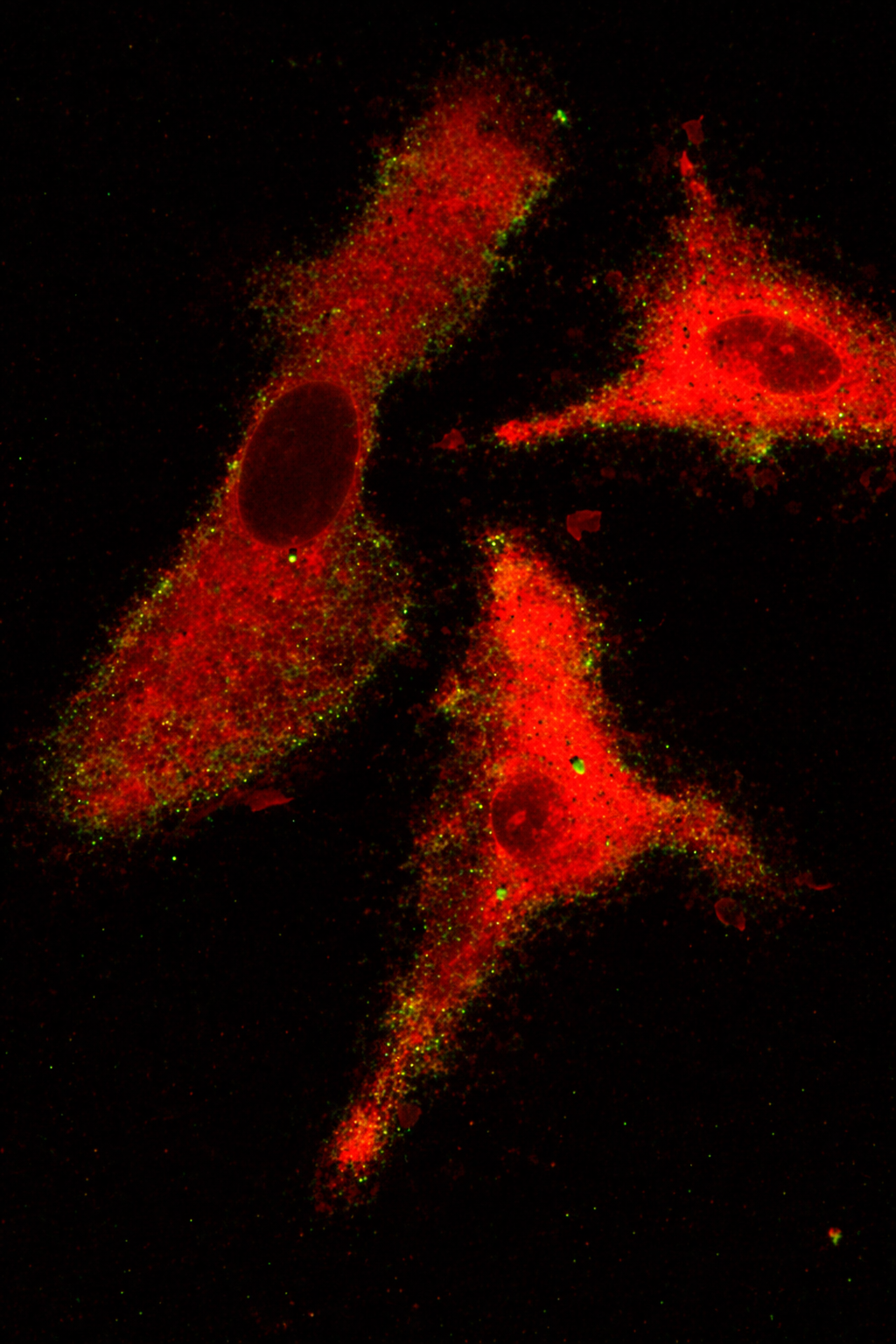
Particle Fusion With Live Cell Membranes
Fluorescence microscopy image of cultured cells following exposure to isotope-labelled nanoparticles. Cells are visualised in the red channel, highlighting the cytoplasmic region and nuclear morphology. The green fluorescence represents isotope-labelled nanoparticles. Discrete green puncta are observed associated with the cell periphery and distributed within the cytoplasmic space, suggesting membrane interaction and intracellular localisation of the nanoparticles. The spatial distribution of the green signal relative to the red cellular stain indicates close association with the plasma membrane and internal compartments, consistent with cellular uptake following nanoparticle exposure.
Improved oxygen and nutrient delivery enhances cellular respiration by supporting mitochondrial oxidative phosphorylation. When more oxygen and key metabolic substrates such as glucose, fatty acids and amino acids are efficiently delivered into the cell, mitochondria can generate ATP more effectively. Increased ATP production supports muscle contraction, endurance, recovery and overall cellular energy performance.
Oxygen Utilisation & Delivery Efficiency
Oxygen was selected as the primary system target because:
- It is central to aerobic energy metabolism
- It directly influences mitochondrial ATP production
- Its utilisation efficiency degrades measurably under fatigue
- It provides a clear physiological proxy for cellular access dynamics
EI8HT does not aim to increase total oxygen availability or manipulate blood parameters.
Instead, it focuses on:
- Supporting oxygen interaction efficiency at the cellular boundary
- Improving utilisation kinetics under high metabolic demand
- Enhancing oxygen-dependent process responsiveness during repeat efforts
This distinction is critical:
EI8HT does not create new capacity. It improves access to existing capacity under load.
Cellular Interface Behaviour Under Fatigue
During repeated high-intensity efforts:
- Diffusion gradients become less favourable
- Membrane transport efficiency degrades
- Mitochondrial utilisation responsiveness slows
- Oxygen-dependent reaction rates decrease
These changes reduce effective aerobic contribution even when cardiovascular delivery remains adequate.
EI8HT is designed to stabilise this interface behaviour by supporting:
- Oxygen interaction stability
- Utilisation pathway responsiveness
- Delivery kinetics during transient high-load periods
This allows working muscle tissue to sustain intended output more consistently.
Why This Impacts Repeat Performance
When utilisation efficiency is supported:
Athletes may observe:
- Reduced performance drop-off across repeated efforts
- Improved tolerance of sustained workloads
- More consistent pacing ability
- Improved recovery kinetics between bouts
- Greater ability to express existing VO₂ capacity
Importantly:
This does NOT represent structural adaptation. It reflects improved performance expression under fatigue.
VO₂max Observations
In trained populations, VO₂max testing outcomes are often limited by peripheral fatigue and utilisation constraints rather than central cardiovascular limitation.
When utilisation bottlenecks are reduced:
- Athletes may sustain maximal workloads longer
- Oxygen uptake curves may improve
- Measured VO₂max may increase temporarily
This represents improved access to existing capacity rather than changes in underlying cardiovascular fitness.
Academic Foundation
The EI8HT platform is informed by more than a decade of academic research into:
-Microbubble delivery behaviour
-Cellular interface oxygen interaction
- Utilisation dynamics under physiological stress
- Delivery efficiency modelling
This includes work conducted in collaboration with leading biomedical engineering research groups including contributions from Professor Eleanor Stride’s team (University of Oxford) in ultrasound and microbubble delivery behaviour.
This body of work provided foundational insight into:
- Controlled micro-transport behaviour
- Stability under physiological conditions
- Cellular interface interaction dynamics
These principles informed the translational performance application of EI8HT.